The Ultimate AI & Machine Learning Glossary: 50+ Key Terms Explained
Your complete guide to understanding the language of artificial intelligence. This glossary breaks down complex AI and Machine Learning terms into simple, clear definitions.
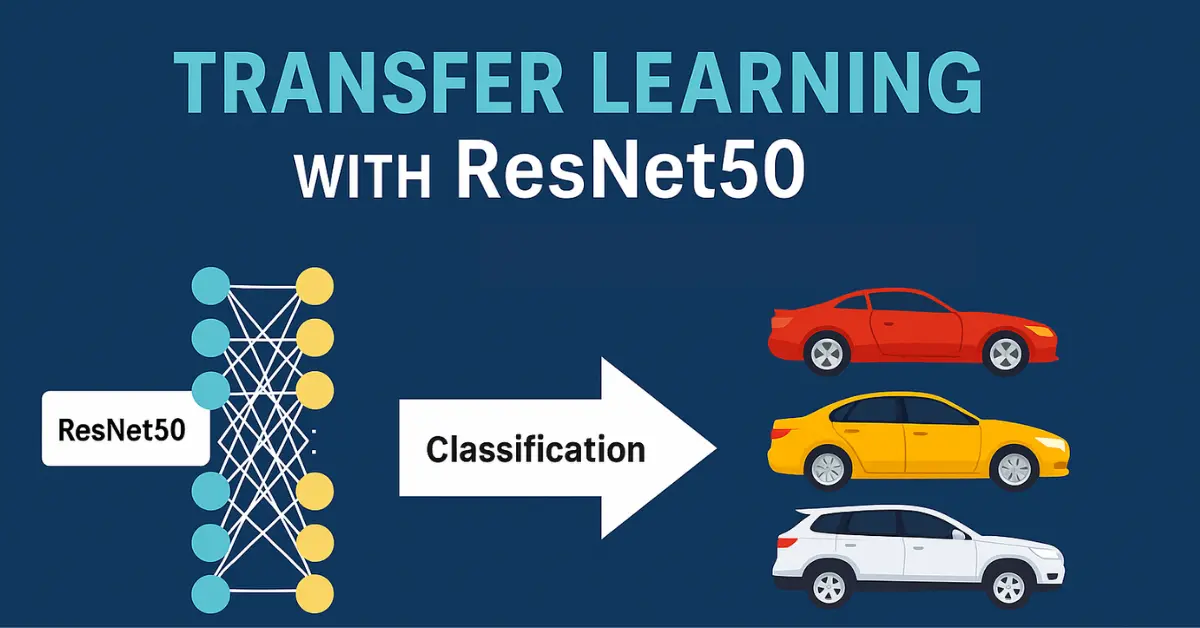
Practical Transfer Learning with ResNet50: build the pipeline, control overfitting, and evaluate on Stanford Cars with accuracy curves and a confusion matrix—no fine-tuning
Learn how to predict League of Legends match outcomes using logistic regression with PyTorch. An easy-to-follow introduction for beginners exploring practical machine learning concepts with gaming data.
Discover how linear regression works in machine learning and how to implement it using PyTorch. This beginner-friendly guide covers key concepts like predictions, loss, gradient descent, and model training—explained clearly with real-world analogies and visuals.
Evaluate your trained machine learning model and use it to make predictions. Understand key metrics like accuracy, precision, and recall in this hands-on guide!
Learn how to build a simple machine learning model in Python using the Iris dataset. In this part, we will step-by-step train our model.
Learn how to build a simple machine learning model in Python using the Iris dataset. Follow this step-by-step guide to train, evaluate, and make predictions with scikit-learn.
You'll understand how backpropagation helps neural networks learn by minimizing errors. We break it down step by step in simple terms!
New to PyTorch? This beginner-friendly guide explains tensors clearly and shows how to create and use them easily, even if you've never coded before!
This article explores supervised vs. unsupervised learning, explaining their key differences, how they work, and real-world applications.